
Ultimate Guide to Habit Tracking: Benefits and Strategies
To maintain a habit over the long term, one highly effective and straightforward strategy is to maintain a dedicated habit tracker. Here’s the reasoning behind this approach: Top performers across various fields frequently engage in measuring, quantifying, and monitoring their advancement through mu
To maintain a habit over the long term, one highly effective and straightforward strategy is to maintain a dedicated habit tracker.
Here’s the reasoning behind this approach:
Top performers across various fields frequently engage in measuring, quantifying, and monitoring their advancement through multiple methods. Every small data point delivers valuable feedback, serving as an indicator of whether they are advancing toward their objectives or if adjustments to their strategy are necessary.
Gabrielle Hamilton, a renowned chef based in New York City, offers an excellent illustration of this principle. In a conversation with the New York Times, she explained, “The key distinction I observe between professional chefs and home cooks is our constant tasting of every element, even down to individual grains of salt, before incorporating it into the dish. We sip olive oil from shot glasses, swirling it in our mouths like fine wine to discern its qualities. We sample the lamb, the fish, the butter, the milk prior to use… we even chew plain salt to evaluate its texture on our teeth and tongue, and to gauge its flavor intensity and saltiness.”
For chefs, this tasting process reveals whether they are progressing toward the perfect dish. It supplies the instant feedback required to fine-tune the recipe precisely.
Much like a chef refines a recipe via experimentation and adjustments, we refine our personal habits through similar trial-and-error processes. If a particular method fails to produce the intended outcome, we modify it—akin to a chef altering the quantity of a specific ingredient.
Nevertheless, a crucial distinction exists between receiving feedback during meal preparation and obtaining it while developing a habit. In habit building, feedback is frequently postponed. It’s straightforward to sample an ingredient or observe dough rising in the oven. However, gauging progress in habits can be challenging to perceive visually. For instance, after a month of running, your physique might not yet reflect noticeable changes. Or after sixteen consecutive days of meditation, you might still experience stress and anxiety in your professional environment.
Forming habits resembles a marathon rather than a sprint. It typically requires considerable time for the anticipated benefits to materialize. While awaiting the accumulation of long-term rewards from your consistent efforts, you require motivation to persist in the immediate term. You need prompt feedback affirming that you’re on the correct trajectory.
This is precisely where implementing a habit tracker proves invaluable.
The Habit Tracker Explained: Definition and Functionality
A habit tracker represents a straightforward method for recording whether you’ve completed a specific habit on any given day.
The simplest version involves using a calendar and marking off each day you successfully follow through with your routine. For example, if your meditation sessions occur on Monday, Wednesday, and Friday, you place an X on those respective dates. Over time, the calendar evolves into a visual chronicle of your ongoing habit streaks.
![Image 1]()
To streamline this entirely, a specialized Habit Journal has been developed, featuring twelve dedicated habit tracker templates—one corresponding to each month. Your only task is to list your chosen habit and begin marking the days as they pass.
Drawing an X for each completed day establishes the traditional aesthetic. Personally, I opt for a more artistic flair by shading the cells within my tracker. Alternatives include using checkmarks or filling cells with small dots.
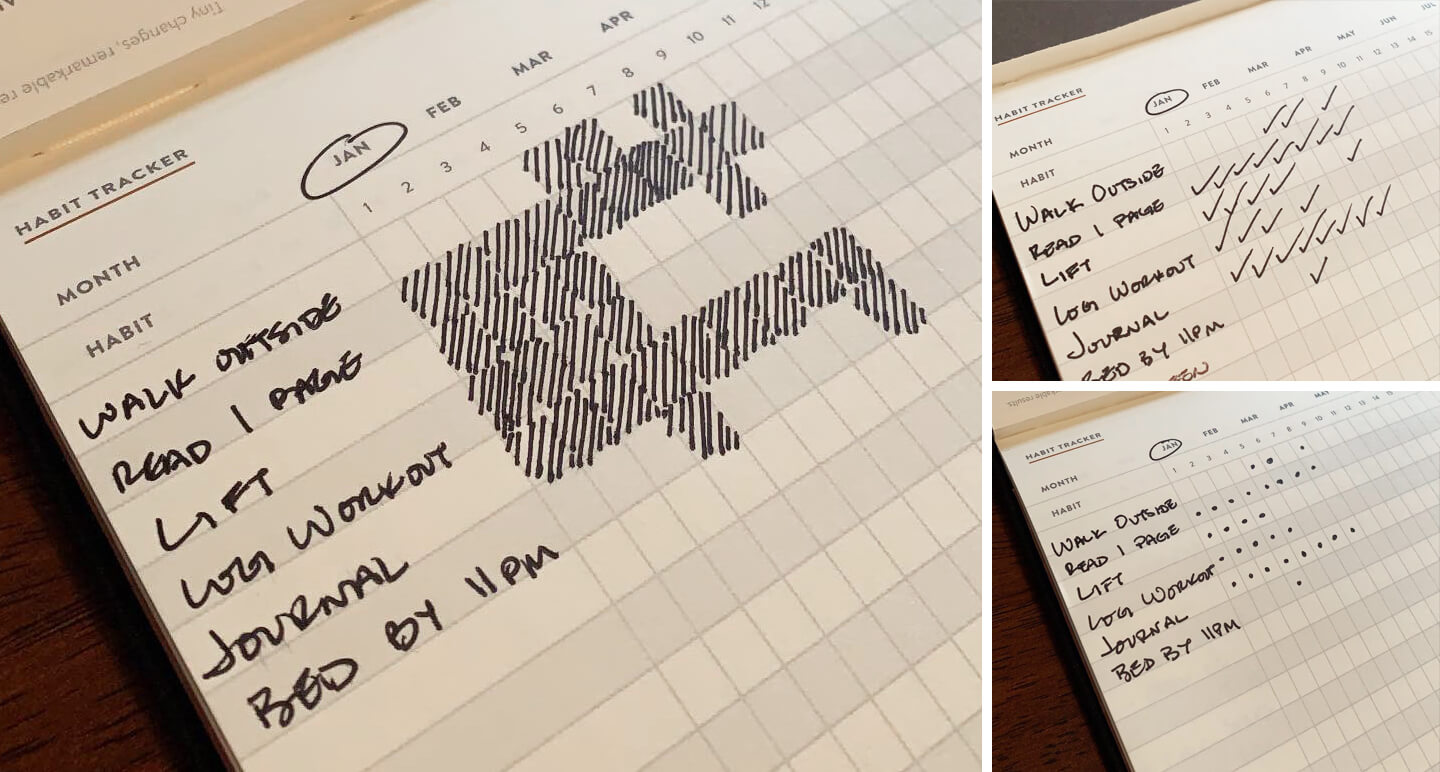
Regardless of your preferred marking style, the essential advantage is that your habit tracker delivers instantaneous proof of habit completion. It acts as a clear signal of your forward momentum. Yet, its utility extends far beyond mere confirmation…
Habit tracking holds significant power due to three primary advantages.
- It generates a visual prompt that encourages action.
- Observing your progress proves highly motivating, as no one wishes to interrupt a streak.
- Recording achievements in real-time delivers a sense of immediate gratification.
Let’s examine each of these benefits in greater detail.
Advantage #1: Habit Trackers Serve as Action Reminders
By its nature, habit tracking constructs a sequence of visual reminders. Glancing at your calendar and noting your streak naturally prompts you to continue the behavior.
Scientific studies confirm that individuals who monitor their goal progress—such as weight loss, smoking cessation, or blood pressure reduction—achieve superior outcomes compared to those who do not. Research involving over 1,600 participants revealed that daily food loggers shed twice the weight of non-loggers. A habit tracker simplifies behavior logging, and the simple act of documentation often ignites the impulse for positive modification.
Moreover, habit tracking promotes accountability. We frequently overestimate the quality of our actions. Precise measurement counters this self-deception, illuminating actual daily behaviors. With undeniable evidence presented clearly, self-rationalization becomes far less feasible.
Advantage #2: Habit Trackers Fuel Ongoing Motivation
Progress stands as the most potent motivator. Receiving confirmation of advancement intensifies the drive to persist along that course. Habit tracking can thus create a compelling, almost addictive cycle of motivation, where each minor success amplifies your commitment.
This effect shines brightest during challenging periods. When morale dips, it’s effortless to overlook prior accomplishments. Your habit tracker counters this by offering tangible visual evidence of dedication—a gentle nudge highlighting your journey thus far. Additionally, confronting an empty daily square each morning spurs initiation, as preserving the streak outweighs temporary reluctance.
Advantage #3: Habit Trackers Deliver Instant Rewards
Tracking inherently feels rewarding. The act of crossing off to-do items, logging workouts, or placing an X on the calendar evokes pleasure. Witnessing your accomplishments accumulate reinforces endurance, as positive sensations encourage repetition.
Habit tracking also maintains focus on the system over outcomes. Rather than obsessing over chiseled abs, the emphasis shifts to sustaining the streak and embodying the identity of someone who never skips sessions.
Practical Habit Tracker Suggestions
These benefits are compelling, yet it’s unwise to overcrowd your tracker with every daily routine. Tracking established habits feels redundant. Instead, reserve tracking for novel behaviors needing momentum or those prone to neglect amid busyness.
Drawing from established principles, scale habits via the Two-Minute Rule, reducing them to two minutes or less. This ensures consistent, minimal engagement daily. Below, examples are categorized by frequency: daily, weekly, and monthly.
Popular daily habits for tracking:
- Journal one sentence
- Read one page
- Meditate for one minute
- Perform one push-up
- Stretch for one minute
- Write one item of gratitude
- Make your bed
- Wake up by a set time
- Go to bed by a set time
- Take a shower
- Floss your teeth
- Weigh yourself
- Take prescribed medication
- Consume vitamins or supplements
- Practice an instrument for one minute
- Contact one potential client
- Prioritize your to-do list
- Say “I love you” at least once
- Put away all dishes
- Take a walk outdoors
- Call your mother
- Walk the dog
Observe that nearly all these can conclude in under two minutes. Design habits for effortless adherence, even on toughest days.
True habits demand frequent repetition, favoring daily practice. Weekly or monthly trackers suit less automatic routines, preventing oversight.
Popular weekly habits for tracking:
- Publish a blog post
- Vacuum floors
- Take out trash and recycling
- Do laundry
- Water plants
- Tidy bedroom
- Write a thank-you note
Monthly habits:
- Review finances
- Transfer funds to savings
- Pay off credit cards
- Pay bills
- Deep clean the house
Habit trackers also quantify frequency, like work travel days monthly.
Additional quantification ideas:
- Days spent traveling
- Conduct weekly review
- Conduct monthly review
Track absences too, termed “avoidance habits,” targeting behaviors to eliminate.
Avoidance habits:
- No alcohol
- No Netflix
- No online shopping
- No soda
- No added sugar
- No caffeine
- No smoking
Pre-designed templates expedite setup, allowing immediate habit listing and tracking without manual grid creation.
Building the Routine of Habit Tracking
Despite clear advantages, habit tracking isn’t universally ideal or effortless. Resistance arises from the dual commitment: the target habit plus tracking itself. Yet, most benefit temporarily or selectively.
To simplify:
Limit manual tracking to vital habits. Consistent monitoring of one surpasses erratic attention to many. Maintain simplicity with three or four priorities.
Log immediately post-habit, using completion as the trigger. This mirrors habit stacking: After [current habit], I will [track the habit].
Examples:
- After ending a sales call, mark “contact 1 potential client.”
- After meditating, fill “meditate for 1 minute.”
- After loading the dishwasher, complete “put all dishes away.”
These cues foster the meta-habit of consistent tracking, ensuring accomplishments are noted promptly.
Strategies for Swift Recovery After Habit Interruptions
Streaks inevitably end. Perfection eludes us. Life interruptions—illness, travel, family demands—arise. My guiding principle: Never miss twice.
Post-miss, resume immediately. One skipped workout is forgivable; two consecutive aren’t. Indulge once, compensate next. Initiate fresh streaks promptly. Imperfection is human; sequential lapses are avoidable.
Initial errors rarely derail; cascading failures do. As noted elsewhere, “One miss is accidental. Two marks a new habit’s inception.”
Avoid all-or-nothing mindsets. Imperfect action trumps inaction. Flawless trackers inspire, but resilience defines long-term success amid life’s chaos.
Duration for Effective Habit Tracking
A frequent inquiry concerns habit formation timelines: 21, 30, 66 days? Studies vary widely by habit complexity.
Underlying query: “When does it become effortless, requiring minimal effort?” Habits ease with repetition, yet this misses the essence.
True duration: indefinitely. Cessation reverts non-habits. Habits embody enduring lifestyles, not checkpoints. Prioritize sustainable shifts for years. Trackers visualize progress, sustaining tomorrow’s commitment.
Certain habits offer quicker feedback, like growing savings or rising word counts, yet trackers universally aid assessment.
Subscribe to the newsletter
Join 50,000+ others who get our content first. No spam, ever.